
Sometimes, no matter how much you shift your mindset or push through difficulties, a project just doesn’t get better. Instead of energizing you, it drains you and stifles your growth. Recognizing this is crucial for your resilience and life balance. It’s time to make a bold decision—quit!
I first learned about the Quitting Framework of Steven Bartlett via Ali Abdaal’s Deep Dive podcast. The framework emphasizes intentional living and strategic quitting, helping you make thoughtful decisions when facing challenges that no longer align with your goals. I feel that this is something that may be hard for people—including myself at times. And that is why I wanted to share this simple framework with you:
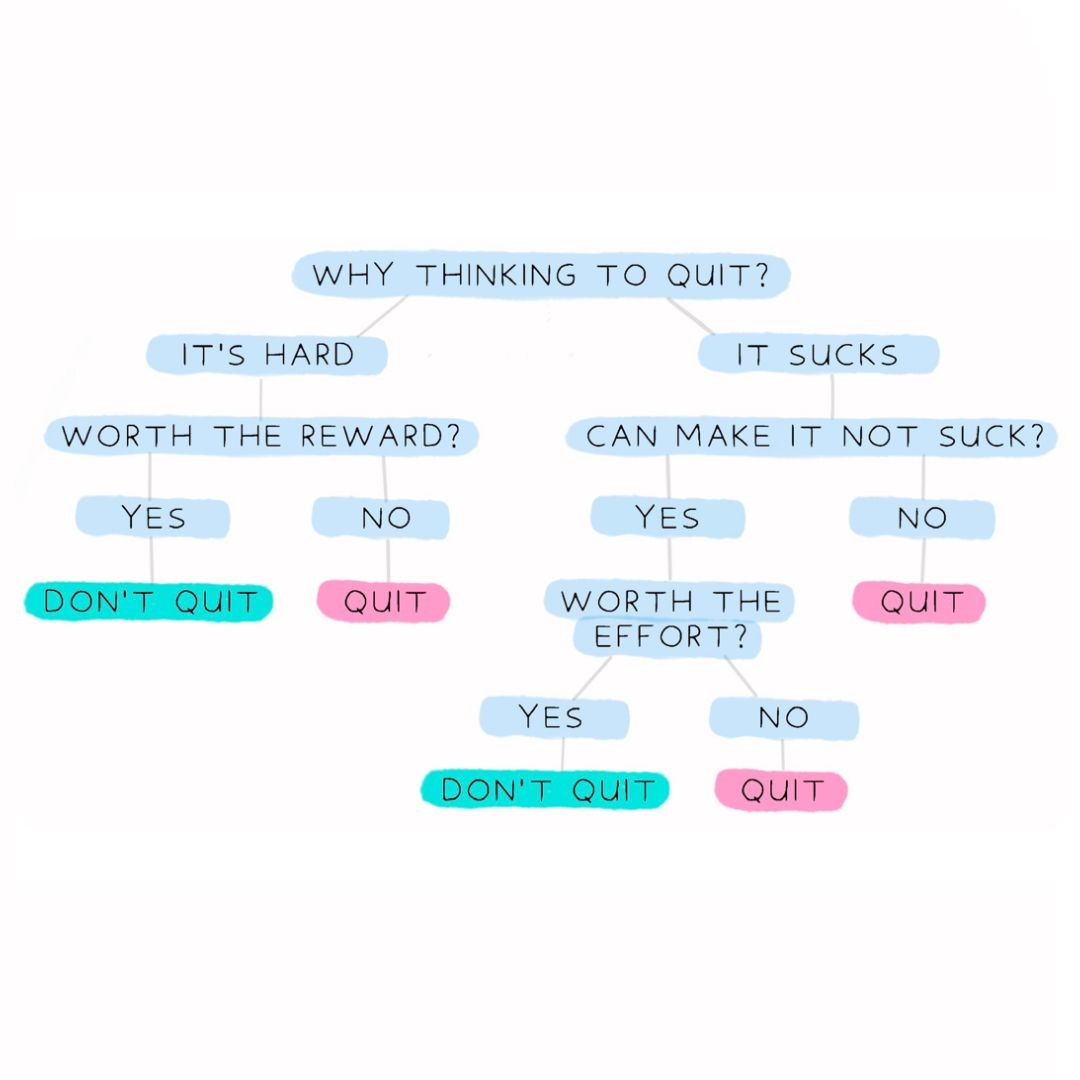
The decision tree above helps you determine whether you should quit based on valid reasons—the hard work is not worth the reward, or it simply, hopelessly sucks—or whether you’re merely reacting to temporary difficulty.
While reviewing this framework, one sentence struck me as particularly important: “Quitting is for Winners.” I think this perspective deserves some elaboration. In my experience—and I have to believe I’m not alone in this—quitting a job, relationship, or project is often perceived as failure. It can feel like quitting demonstrates a lack of perseverance, resilience, or that you simply weren’t up to the task. But reframing quitting as a strategic decision shifts this narrative.
By the end of 2017, I quit my first bachelor’s program because I felt it wasn’t taking me where I wanted to go. The topics remained shallow after a year of study, and I wasn’t learning as much as I could. Even though I had consciously decided to quit, I felt a sense of failure when explaining my decision. I found myself justifying it by mentioning my good grades or clarifying that the problem wasn’t me.
But through quitting, I found a more fulfilling path in a program in Philosophy which really challenged me—in a good way. It was one of the best choices I’ve made because the path I initially chose at 18 simply wasn’t right for me. There are many valid reasons to quit, and quitting does not mean failure. If you quit the right things, you win.
Now, I encourage you to reflect on a project or commitment you have been struggling with. Does it serve your growth, or is it holding you back? Use the Quitting Framework above to help you guide your decision, and don’t be afraid to make space for something better that supports your growth. 🫴🏽🌱
Banner Photo by Anwaar Ali on Unsplash
Discover more from Itching for Growth
Subscribe to get the latest posts sent to your email.
 Itching for Growth
I have quit quite a few things in my life when they did not seem to serve a purpose – or in one instance, became dangerous. On a regular basis I stop working on a draft that just doesn’t seem to be going anywhere. That is ok. I usually keep it because sometimes a snippet of it will be perfect for another piece.
There is the story about a man who comes to a sage for wisdom and the sage pours tea in his cup and keeps pouring and pouring until the tea overflows onto the table. The man asks him to stop. The sage says that one cannot fill with wisdom if his cup is already full. I guess that means sometimes we have to empty the cup of the old so we can fill it with the new.
Great post, Marie. Keep it up. :)
LikeLiked by 1 person
Thanks for sharing your thoughts and for this captivating anecdote, it is a great addition to the idea indeed 😊. I think there is a lot of wisdom in what you mention: even though a draft may not be headed in any direction, part of it may still prove valuable at a later point. The effort put in does not have to be in vain.
LikeLiked by 1 person