
It shouldn’t be hard to picture this scenario: a couple of months ago, you committed to a project. Maybe it’s work-related, a hobby, or something you’re doing to help someone out. In the past few days—or maybe even weeks—doubts have started to creep in. Do I actually want to do this? Should I pursue this goal, or is it a waste of time?
I’ve written about quitting and persevering multiple times now, and I still find it one of the trickiest topics to get my mindset straight on. Abandoning something you’ve invested time and energy in feels painful. It can feel like losing something valuable. Maybe if I’d just pushed through a little longer, it could have become something great…
But continuing with something just because you’re afraid to let it go? That’s a whole different kind of pain you’re signing yourself up for.
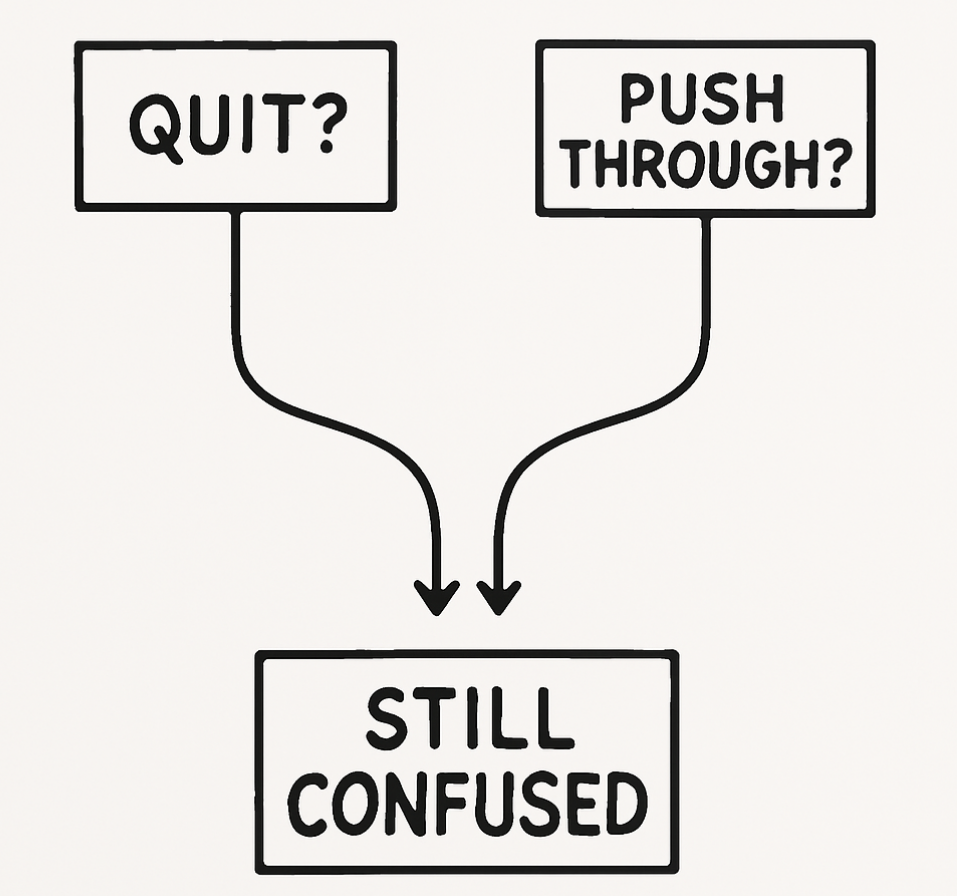
To be honest, I still have no idea when to quit and when to push on. I’ve made decisions I wish I could go back and redo. I wish I hadn’t quit piano and sold my keyboard. I still feel uneasy about my decision to leave academia, wondering if I fit better there. I wish I had handled some relationships differently.
But sticking with things out of sheer commitment hasn’t always paid off either. It’s led to a string of master’s courses I should have dropped, two long unhappy relationships, and a brain full of half-finished projects that I can’t let go and keep revisiting in a semi-adequate, half-hearted way.
I’m sure you have your own list—times you wish you had either walked away sooner, or stayed in the game longer.
So… What is the lesson here?
The Role of Uncertainty
The key factor that makes these types of decisions so incredibly hard is that the outcome is uncertain. Unpredictable. Quitting means missing out on opportunities you might have otherwise had. But so does persevering. And you won’t know what those opportunities were until you’ve lived through one path or the other.
If we can’t comprehend the full range of outcomes, however, we can’t be entirely be responsible for them either.
A Framework on Quitting
I know of the Quitting Framework by Steve Bartlett which can be roughly summarized in a flow chart you can go through to determine if you should quit a project or relationship, or stick to it.
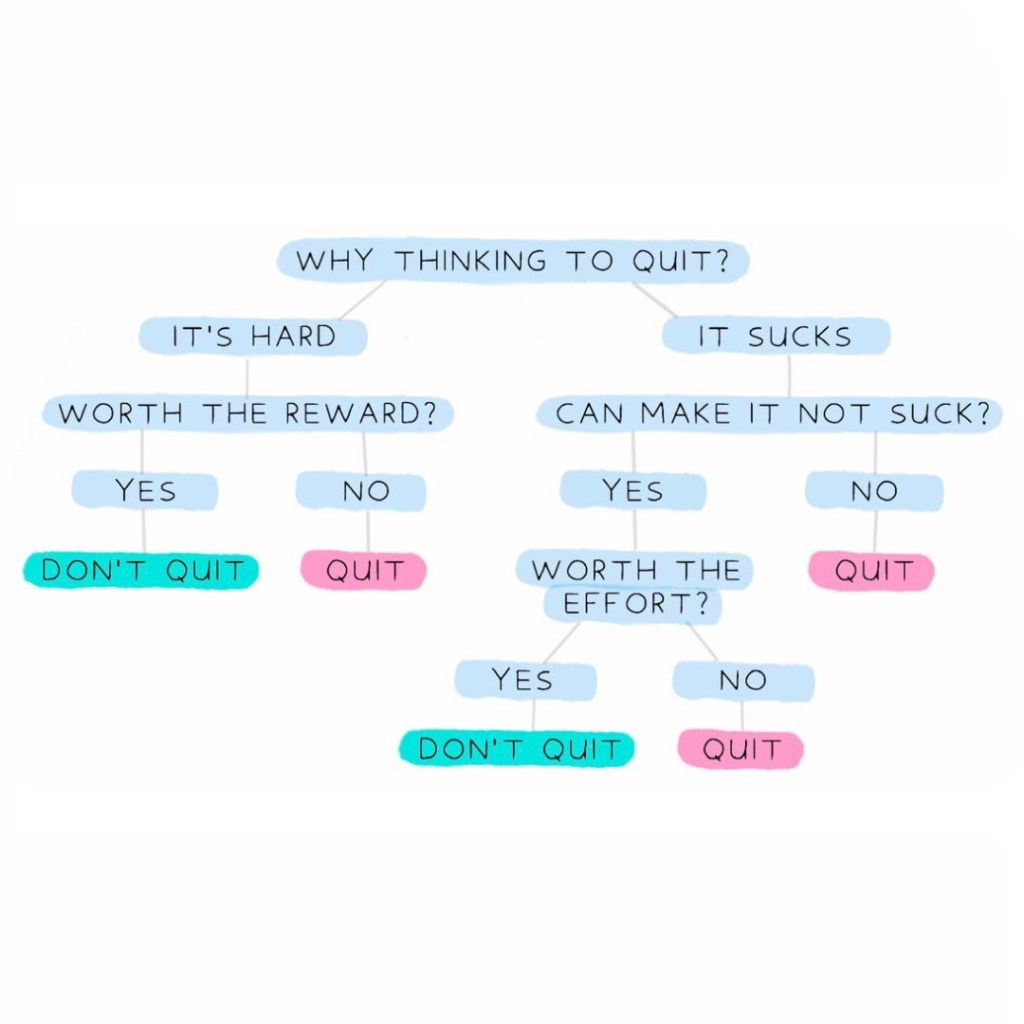
However, the framework does not take away the uncertainty. How can I know if something will be worth the effort and hardships?
Short answer: you can’t.
Right or Wrong Decision?
One of the most important things we can do for ourselves is recognize that we’re always making decisions based on limited, subjective, and incomplete information. This applies to every choice we face—whether it’s picking a dish at a new restaurant (will it be any good?) or choosing a life partner. We never have, and never will have, all the information.
The point isn’t that you’re free from responsibility for your choices—you’re not. But you aren’t responsible for the outcome. What you do control, and are responsible for, is how you choose to act: whether you continue or walk away.
My advice—offered as much to myself as to anyone else—is to act in line with the kind of person you want to become. Don’t get caught up in how external outcomes might shift depending on whether you quit or keep going.
Instead, turn your attention inward. Let’s take a moment right now and ask yourself: Do I want to be someone who works on this kind of project? Someone who’s in this type of relationship? Someone who acts this way? Let your identity, not just the outcome, guide your choices.
Further Reading
Quitting Is Not For Losers, Quitting Is For Winners.
The Sunk-Cost Fallacy: Your Energy Is Not Lost
Growth Over Comfort: Transforming Toxic Environments
Discover more from Itching for Growth
Subscribe to get the latest posts sent to your email.
 Itching for Growth